As I enjoy my "Summer of Reading II" in North Carolina, I'm pursuing my usual form of paid employment -- physical processing for the massive manuscript collection of Kenan Professor of Humanities Allen Mandelbaum.
As discussions about history, futurism, time and Lindow Man raise questions over at In the Middle, I was struck to find this beauty in the folders I was sorting through today: At first, I found this appropriate -- Professor Mandelbaum writes everything by hand, of course there would be a floppy disk! Of course, then the obvious flaw in that statement became apparent: this was technology back in the day, in fact, these were once the height of technology. Now all our technological present is built on the "floppy" disks of yore. In a way, though distinctly not human, this technology carries with it a literal message from the past (the afterword to Professor Mandelbaum's book) but also a more figurative one -- sometimes information (data, narratives of data) can become inaccessible, even in this day and age. I suppose there's a way to get at the writing on this disk -- but who wants to go that far out of their way. It's in the book -- isn't it? I've made several summers now of scouring various versions of Professor Mandelbaum's manuscripts -- but when I come across a disk, it's a kind of blank space. I'll believe the label.
I wonder what someone from 1000 years hence would think of an accidentally preserved floppy disk.
Friday, July 13, 2007
Moments with the Mandelbaum Collection
Thursday, June 15, 2006
Moments with the Mandelbaum Collection
Another excerpt from my manuscript collection processing labors at Wake Forest ZSR Library Special Collections :
As I was digging through another couple of accordion folders of stuff yesterday (well, Monday -- so now it's two days ago), I came across a folder of materials from Mandelbaum's translation of The Odyssey. Part of that folder was a near final draft of the published afterword of the book, the opening of which contains some wonderfully meditative lines on translation:
Translation exacts and invites much micro-labor, many days in the burrows. (Though the frequency of controversy in questions Homeric often makes the burrows seem more like trenches.) Emerging at work's end, one hopes the labyrinthine time will, in its result, be informed by--and shed--light. One blinks--and feels compelled to chart the works that accompanied the burrowing.
I like the image of the labyrinth that Mandelbaum evokes here. I'd say more -- but I think I'll just let his words stand.
In other news...am attempting to finish a paper on Bede and Chaucer as well as get both re-started and finished on something about The Wonders of the East. And all of this -- is for a deadline that seems now to be earlier than I'd anticipated. Yikes! So that's where I'll be over the next week or so. With the brief exception of what looks to be my only beach trip this year, to Hilton Head, this weekend. So with a little luck, I'll relax at least a bit. My beach reading -- two books that are non-academic:
1. The Cryptonomicon, by Neal Stephenson. Recommended by a friend earlier in the year -- am finally picking it up now (am 50 pages in already in fact!).
2. Airman's Odyssey by Antoine de Saint-Exupery. I've loved St-Ex since I was a child. Reading Le Petit Prince is a yearly event for me, and I stole my mother's French copy for that express purpose. I've avoided his other works for fear of being disappointed, but another friend recommended this, and as his last recommendation turned out wonderfully, I decided to pick it up. Reading the Introduction, I was taken by these words that Richard Bach writes about St-Ex:
Adventure and reflection -- that's how he makes lifelong friends of kids with polishing rags. He invites communication, and he stays around to talk in spite of what happened that last day of July, 1944.
The world, he said, it isn't Us and Them, it's only Us!
Once set afire, ideas burn until they're quenched in action. Twenty years from now, in the night cockpits and passenger cabins of our hypersonic transports, on the soft-lit decks of our space colonies, will a lot of kids turned friends of his ideas be seeing them for truth, watching the planet turn safely beneath their wings?
What would he say if they told him that he hadn't died in the war?
If the stories hold a mere half of the promise Bach finds in them, they will be stunning. But somehow, I think it's a safe bet they'll hold far more than that -- and will outstrip even the wildest of those promises.
Friday, June 09, 2006
an intervening post
[Which of course means that Summer Seminar Part II is still in progress. What can I say -- I appear to be learning to procrastinate even from my procrastination.]
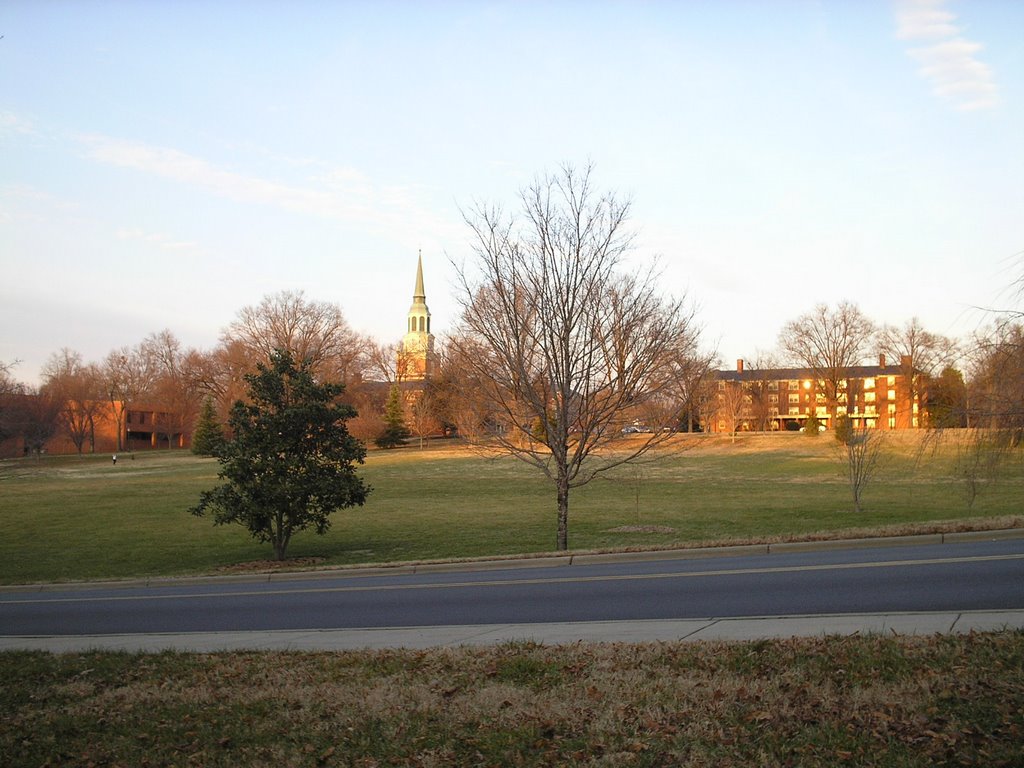
So I finally remembered to ask my boss if it's ok to blog about what I've been doing at work. As she's given me the go-ahead, I've decided there is no time like the present. As I may have mentioned before, I'm spending the summer working at the library of the small southern university I attended as an undergrad -- Wake Forest (see the picture above -- and yes, I'm an incredibly lucky person to have attended someplace so gorgeous. That picture was taken in DECEMBER). My job, more specifically, is in the Rare Books Room and I'm currently doing the physical processing for a new manuscript collection that was donated by one of our professors.
So, for the moment at least, the theme of my summer is Metamorphoses. I italicize that not for effect – at the moment, my life is caught up in a translation of the Metamorphoses of Ovid, published in 1995 by poet and translator Allen Mandelbaum. It's liable to be a name that seems familiar -- after all, he translated The Divine Comedy, The Aeneid, The Odyssey. My job this summer? To sort everything out, beginning to create a workable structure so that other scholars can go through the materials and see what's what, be able to find what they're looking for. There's a great deal of material, mostly related to his many publications.
Needless to say, when my boss offered me my old job back for the summer I was thrilled -- this is a pretty stunning opportunity for a medievalist, as Allen Mandelbaum is one of the most erudite professors I've met, and an incredibly talented translator. I'd meant to take his Dante class while in undergrad -- I didn't try for it my sophomore year, and though it was to be offered again when I was a senior, the class was cancelled. I was disappointed, and figured my chance to work with Dr. Mandelbaum was over.
And then my boss asked me to work on the physical processing of Mandelbaum's papers. I've been consistently amazed by the sheer size of the collection, from the first time I laid eyes on it last August. Shelves of brown expanding files, filled with materials and labelled by project and content. I managed to fill an entire book truck with only folders related to the Ovid translation. Much has been done to organize it already, and that's a good thing -- even with the most preliminary organization done, there's still a great deal to work through, sort out, and archive properly. And I know there's more to come, too -- there's still a lot in Dr. Mandelbaum's office that I haven't even looked at, aside from a casual glance when I met with him late last summer.
As I've gone through the papers related to Ovid, I've been overwhelmed by the work that went into both translating the work and to documenting it. Xeroxes of every notebook. Everything preserved, and written, more importantly, by hand. Dr. Mandelbaum is of another school of work -- he doesn't type. Everything is done in handwriting, and his is exquisite.
I've seen multiple drafts of several pieces, ranging from preliminary notes to final galley proofs. From the Afterword, there's a part where he describes his invocation of Ovid in his own poetry, The Savantasse of Montparnasse, and seeing the way this develops, from handwritten copies (strewn with marked out sections, and notes Mandelbaum wrote to himself), through a couple typed versions with annotations where things were to be changed, to the proof phase and finally to the book has been really interesting. The meticulousness is remarkable, and I think it's a rewarding precision -- for example, an excerpt from the final version, which you can find in a copy of the book:
"Finally, it was the author of the Matmorphoses whom I had invoked as benevolent, confederate spirit for my own Savantasse of Montparnasse, where my prelude saw him as:
Ovidius-The-Garrulous,
The-Copious, the Ever-Swift,
Amir-Of-Metamorphosists,
and Sad-Seigneur-of-Scrutinists,
calling on his 'fraternal breath' in the hope that he would 'sustain, support, be staff and stead / for both The-Reader and The-Read.'"
There's something in these lines that sends my thoughts in all sorts of directions -- I love the emphasis he's putting on the distinction (or perhaps connection?) between "The-Reader" and "The-Read." It seems to imply a reciprocity in the relationship between reader and text that I think is really interesting. Or perhaps I want to see it more as a veiled illusion to the role of translator...and writer, of course, since this is Mandelbaum's own poetry.
Well, in lieu of the long thought process that used to go here (it was relatively incomprehensible and involved Benjamin and many thoughts about translation that I should really think through more before attempting to write down at 2 AM -- the blogspot gods were kind enough to delete them, however, so we're all saved my ramblings for the moment...but only for the moment) I will point you in the direction of Wake Forest's ZSR Library.
The Mandelbaum Collection is not ready to be put on the website yet -- eventually it will include an online finding aid, which I am preparing the preliminary notes for even now. However, the Special Collections website does include a variety of materials from collections that are already accessible in the Digital Collections. I've had the pleasure (and, frankly, honor) to be a part of the initial phases and sorting of many of these collections, so here are a few of the highlights of projects that I've played a small part in:
*The Dolmen Collection -- Liam Miller's Irish press, which was founded in 1951 and continued until his death in 1987. Wake Forest's Special Collections are home to the full archives of the Dolmen. Online, you can see a finding aid (which lists all the materials in the collection) as well as images of the printing blocks used in publishing, which are quite lovely.
*The Confederate Broadsides -- Fascinating poetry from the Civil War era.
*The Ronald Watkins Collection -- A wonderfully diverse collection from the former school teacher at Harrow-on-the-Hill, whose work on the performance of Shakespeare advocated the view that the language itself was enough to substitute for any "special effects" one might be compelled to add to the plays. This was the first collection I did the physical processing for in Rare, and it was certainly a treat!
These are just a few of the holdings, and I'd encourage those looking for even more "legitimate procrastination" to check it out. It's an incredibly valuable resource to have around. Of course, I'll be updating about the Mandelbaum Collection as the project moves along this summer. My work in Rare has taught me a lot about what scholarship involves, and how much work goes into making resources available. It's a fascinating process, and one I'm grateful to get to be a part of in my academic life.