Wednesday, June 06, 2007

the Knowledge of Monkeys Higher Primates HUMANS

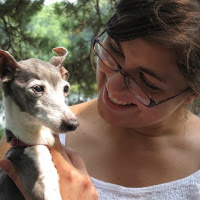
Well, I've finally settled into a viable summer routine. I use my mornings (about 8 AM until noon) to work on the Allen Mandelbaum collection. I then grab a quick lunch, take a walk outside to remind myself there's still sunshine and sky, and then settle into my favorite place on the sixth floor of ZSR library at my alma mater, Wake Forest, and I read. Finished De Trinitate today. Shall begin City of God tomorrow. I spend the last half hour of my day outside reading, if it's nice, waiting for my ride home (ah, the joys of carpooling with my mom -- she knows as much about Augustine as I do this week, given that I'm so desperate for human contact at the end of the day I tend to babble on and on about temporality for the entire twenty minute drive home. She's a very patient woman). I come home, have dinner, go for a run, and then zone out in front of the TV with my sisters and my adorable Italian Greyhound puppy (who's twelve, but never mind). Somehow, in the midst of all this, I rarely find time to catch up on emails. But I'm working on getting email time in there somehow.

But over all, it's good to be home.

However, to make my morning of sorting go a little faster, I've taken to listening to NPR podcasts (with the BBC world service mixed in) to help me engage intellectually when Dr. Mandelbaum's papers get repetitive. This morning, I listened to Fresh Air, and there was a very interesting commentary on Wikipedia by Geoff Nunberg that has to do with the viability of "human knowledge." I spent the last ten minutes typing this up -- you can download the podcast on the Fresh Air website , and it's in the last ten minutes. I hope that NPR won't mind my reproducing these here. So, Nunberg's closing remarks:

The most exasperating thing about all these arguments about Wikipedia is that everybody seems to assume it’s a single entity, the way an encyclopedia is. The Wikipedians explain how this open collaborative process is lurching toward a neutral and methodical synthesis of all human knowledge. The critics charge that it is undermining the conceptions of expertise and intellectual order that the encyclopedia has embodied since the Enlightenment. But in one form or another, that picture of human knowledge was always a grand illusion, even back when we could believe in the unity of high culture. By now the Encyclopedia and the Dictionary are really just symbols that we honor with inattentive piety. Actually, it’s my guess that most of the people who “harumph” about how Wikipedia is nothing like an encyclopedia haven’t actually opened one for some time. But then, Wikipedia is steeped in exactly the same bookish nostalgia. That’s implicit in the name Wikipedia itself, and in the ferociously Oedipal rivalry the Wikipedians feel with the Britannica. And it explains the exaggerated deference that Wikipedians pay to published sources, even though a lot of the books and articles that contributors cite turn out to be no more reliable than Wikipedia itself. The irony is that Wikipedia really signals the end of the Encyclopedic Vision. It’s only when you actively try to implement that view of collective knowledge that you realize how fond and delusional it is. You deposit this multitude of strangers in a single place, you shouldn’t be surprised when you come back and find nothing but a jumble of footprints in the mud. That’s actually a fair picture of what human knowledge has always been. But it was never so evident before now.

So I guess the answer's in -- infinite monkeys + infinite time + infinite typewriters will never = Shakespeare. But with all that said -- I have to wonder still. We're not developing a perfect system of knowledge, and we know that there's no such thing as a coherent, unbiased collection of all things that are "known." But I can't help but ask -- isn't there also some inherent value to the variations of those footprints? Could that be the most human knowledge of all?

Read More...

Sunday, June 03, 2007

Last of the Time Lords

I've been watching the new Doctor Who series on the BBC for about six months now -- ever since it quite randomly came on the television after some other show I'd been watching with a few British friends. I was assured that I would "love it" -- and love it I have, as I've been following it a bit obsessively ever since.

For those who don't know the show, a BBC website can provide some background if you're interested. All you really need to know is that the series revolves around a character called, simply, the Doctor. He is the last of a race known as the Time Lords, and the series follows his adventures traveling through space-time in the TARDIS (which if memory serves stands for Time And Relative Dimension In Space), which is a space-timeship disguised as a police call box. He has various companions over the years, including a young girl named Rose in the first two seasons of the most recent series, and a young doctor named Martha in the most recent season. The show has enjoyed a pretty much unparalleled longevity, thanks to the fact that the Doctor's race, the Time Lords, don't die -- they just change form. Same doctor, different face. Thus, the slightly nerdy looking yet oddly compelling David Tennant now plays the doctor, where formerly Christopher Eccleston played our space-time traveling hero.

In the most recent episode, called "The Family of Blood", the Doctor is given a chance to become human -- in fact, he must become human to hide from alien creatures looking to hunt him down in order to absorb his immortality. He is given the chance to have, for a brief period of time, the one thing he can never have -- a life in which he can truly take part, a life in which he is a part of the chronological procession of time rather than an outsider who can zap in and out of it at any given time. Because he is the last of his kind, and because no other race shared their peculiar affinity for time travel, and more importantly, the safe-guarding of time -- he finds himself utterly alone.

Over at In the Middle a week or so ago, we were having a discussion about immortality -- trying to answer or at least begin to answer the question Eileen Joy phrased thusly: "if you could live forever, would you want to? Would you still be human?"

I felt resistant to the question at the time -- too many episodes of Highlander, too much reading of the Lord of the Rings -- I'm still not entirely sure what it was, but there was something about the question that meant, for me at least, that the answer would probably be no -- but I couldn't quite put my finger on what it was at the time.

It doesn't do justice to the conversation there to add an episode of Doctor Who to it. Perhaps, like so many other literary (or televisionary?) answers to this question, it doesn't really "count" if you will -- it's only humans, thinking about what would be wrong with the thing they want most (immortality) if it were, in fact, within their grasp -- a way of comforting ourselves in the face of the one thing in life that is certain. But if you look here, and go to about 8:10, you'll see, in classic Doctor Who style, the answer that springs to mind for me. The line:

In the end, you just get tired. Tired of the struggle. Tired of losing everyone that matters to you. Tired of watching everything turn to dust. If you live long enough, Lazarus, the only certainty left is that you'll end up alone.
Maybe we're just hardwired genetically to reject our mortality, to strive to live beyond it no matter the cost -- but there's another side to that struggle that seems to recognize that, were it different, we would -- whether in one thousand years or one billion -- get tired.

In a way, it's similar to The Wanderer. The part I'm thinking of is near the end -- it's the ubi sunt passage that we so often return to as a lament over the transience of earthly things:
Se þonne þisne wealsteal wise geþohte
ond þis deorce lif deope geondþenceð,
frod in ferðe, feor oft gemon
wælsleahta worn, ond þas word acwið:
Hwær cwom mearg? Hwær cwom mago? Hwær cwom maþþumgyfa?
Hwær cwom symbla gesetu? Hwær sindon seledreamas?
Eala beorht bune! Eala byrnwiga!
Eala þeodnes þrym! Hu seo þrag gewat,
genap under nihthelm, swa heo no wære.


When a wise man beholds these walls,
and contemplates deeply the darkness of life,
he grows wise in spirit. He will often bear in mind,
many of death’s slaughters, and will speak these words:
Where is the horse? Where the warrior? Where the lord?
Where are the banquet-seats? Where are hall’s joys?
Alas for the bright cup! Alas for the warrior!
Alas for the glory of the people! How distant is that time,
vanished under night’s shade, as if it never were!

(Thank you to Labyrinth Library for the OE text. The translation is my own.)


Of course, one could always read this as related to the idea that if humans were immortal, then there would be no reason for such lament -- there would be happiness. But I suppose a part of me -- the pessimistic part of me, to be certain, but a part of me none the less -- thinks that mere immortality wouldn't be enough to light up the "darkness of life." I guess there could be no guarantee that I wouldn't lose something -- or someone -- that I loved. Rilke, in his Ninth Duino Elegy, says something to this effect speaking of objects:
"And these things, whose lives are lived in leaving -- they understand when you praise them. Perishing, they turn to us, the most perishable, for help. They want us to change them completely, in our invisible hearts, oh -- forever! -- into us! Whoever we may finally be."
Of course, Rilke imagines for himself a kind of dynamic between humanity and objects that focuses on what humans can do for "things" -- but I think there's a way to save Rilke from his human-centered vision.

I think there's space in Rilke's poem for a kind of respect that his language elides. In a sense, by respecting what they are (whether human or not, "sentient" or not) and not merely their use to humans -- there's a chance to save ourselves. Again, what I'm going for here is slightly more nuanced than I know how to put into words just yet. It has to do with boundaries, with respect, with limitations. I has to do with knowing when our desires would take too much from things and beings around us -- and with knowing when we must, in fact, allow our own ending to be altered in order to avoid damage to the world and universe in which we live.

In short -- nothing comes without a price (not in a moralistic way, just in a logical way -- energy can't be created or destroyed. Only the form changes, and that form, when it changes, must have been something else before...), and immortality seems like it would draw too much on an already overdrawn environment. Perhaps one day there would be a chance for altering our own ability to live on without the loss and damage that immortality might cause. But until those contingencies are fully mapped out, I think I'm with the Doctor. The "things" (people, animals, plants, worlds) we'd leave behind in our own attempts to be mortal seem too valuable -- and I don't know that I would ever want to be one of those left, asking where it all has gone.


Edit, Monday afternoon -- funny how I managed to leave the "im" off of "immortal" in that last paragraph. I wonder what it might mean to leave things behind in an attempt to "be mortal" rather than an attempt to "be immortal". Typos, while annoying, can also be thought provoking on occasion...

Read More...

Wednesday, May 30, 2007

Kalamazoo 2007

I've written and rewritten this post so many times at this point that if I don't just put it up there, it'll be next May before I do. So here it is, my Kalamazoo, 2007

As an undergrad at Wake, I was given the opportunity to attend the Kalamazoo medieval congress. Part of winning said contest was the requirement that, after the conference, I write a sort of perspective paper on the experience of attending a conference. From the very first time I tried it, I found the whole process incredibly difficult. In fact, I’ve only ever successfully written about the Congress once, despite having won the award that required the post-zoo essay twice. The only place I can manage to talk about Kzoo in writing is in-flight – the transitional space between a place I’ve come from and the next stop on my journey. Fittingly I began this post this somewhere between New York City and Atlanta, and finished it in my hometown of Winston-Salem, NC. This past Saturday night, I attended a dear friend’s wedding – a friend who also happens to be one of the five students who graduated from Wake with me in 2004 who were the intrepid co-founders of the Wake Forest Medieval Studies Student Group (lovingly called Aesir in those early days – I think they stick with a more formal title now, as the group outlasted my generation of medievalists, and still has a yearly conference!). Three of those five Aesir members – including my friend getting married, myself, and another friend who was also at the wedding—met in 2002 in Dr. Overing’s Old English class, which we all took in the Spring of our sophomore year. It’s living proof that difficult classes, like traumatic situations, can bring people together.

Upon my return to North Carolina on Monday evening, I started clearing out my room in preparation for making it a place I can get work done over the next two months. As I was sorting the files my mother’s been trying to get me to thin down since before college, I found the first “post-Kalamazoo” paper I ever wrote. Reading what I wrote about the Saturday evening dance back in 2002, I’m struck with the odd realization that I knew then what Kalamazoo would still feel like five years later:

As I sat, and watched all the madness that was the conference—I realized that this experience was completely unique. For the first time, I was surrounded with people who cared about the same things I do. In this place, everyone cared about what happenedone thousand years ago, and modern literature was involved only in as far as it related back to that period.
Funny how, on the first visit to a professional event – I seem to have felt a little bit like I was arriving somewhere I was always meant to be.

And, to return to the point of this post: what really struck me about this conference was that I seem to have found a “group” of sorts – in both the metaphorical and literal meanings of the word. Kalamazoo 2007 was for me defined by the work done by the BABEL group, and by Eileen’s inspiring paper in the Friday session on Feminisms and Queer Theory. The vision of an “enamored medieval studies” is – and here’s where the “metaphorical” group comes in – a vision that I can want. Karl’s work and the ensuing discussion of the construction of the categories of human and animal (which you can follow here and here, among other posts, at In the Middle) is a question I’ve only just started to “notice” in a sense. My “work”, as such, hasn’t fully developed in terms of its foci. I think for the purposes of the conference I said that the project of my dissertation was “vernacularity and temporality in immediately pre- and post-conquest England” – which is my project – but it’s also still far more than that. For example there are ideas of proto-nationalism, a word I’m not entirely comfortable with because of its modern theoretical and practical weight, that are a part of my project that I haven’t found a way of articulating in a sentence (or a two part title!) yet. Moreover, I find that I’m interested in – and I’m actually using my adviser’s articulation here of what I’m trying to do, as mine is far flimsier – time as it is lived, the intersection of time (both Kairos and Chronos, distinctions Agamben discusses in an article I can’t find the title of at present) with the human. That’s a bit of a digression, but what inspired it is the realization that I’m surrounded by people who are interested in the way that academic things intersect “human” (whatever that means) lives.

Other high points of the year:

  • Kathleen Davis’ paper on Coetzee’s Elizabeth Costello and the function of the “medieval” as the temporal limit against which the modern posits itself.
  • A far more enjoyable dance than I’ve had previously, though I’ve been known to enjoy the event very much in previous years. I refuse to comment on allegations made elsewhere that I sang anything written by Journey. As for Bon Jovi -- children of the 80s can't deny that one, so I will proudly say that I always belt out the lyrics to Living on a Prayer when the opportunity presents itself.
  • The blogger breakfast, organized by the wonderful Dr. Virago, whom I finally had the pleasure of meeting. I was struck by how many bloggers came to the event, and by the interesting conversations I had there. One of the highlights for me was finally introducing myself to Michael Drout -- on my first visit to Kalamazoo he organized several sessions on reading Old English aloud, and a full read-through of Beowulf (which I highlighted in the first of the “post-Kzoo” papers I mentioned earlier). Also, getting to meet all of my fellow bloggers (many of whom I hadn’t met before) was a wonderful feeling – it was good to see so many of us!
  • Seeing some amazing papers on topics I know practically nothing about (including medieval drama) – and realizing that I do have points of intersection between my work and the late middle ages that can bear interestingly on things that seem far a-field. -- and more importantly, that can productively displace the way I see things in my own work.
This was also the first year that I spent relatively little time re-writing my paper during the conference.

But perhaps the highest point of this best of Kalamazoos was the feeling that I can keep working on this medieval stuff. I returned energized, knowing the long reading road ahead of me would be challenging, but also knowing that there are people in my intellectual vicinity who want to push the boundaries of what this work can do, what it can address.

And there is work to be done.

I’m reminded of a Clement and Cixous quote from The Newly Born Woman. It serves as the epigraph for the book Landscapes of Desire, by Gillian Overing and Marijane Osborn:
...she comes out of herself to go to the other, a traveler in unexplored places; she does not refuse, she approaches, not to do away with the space between, but to see it, to experience what she is, what she is not, what she can do...
When I look back on Kalamazoo 2007, I experience something I didn’t quite expect. I feel hopeful.

Read More...

Saturday, May 19, 2007

Lloyd Alexander

Glancing over to Tiruncula's post today,, I was sad to find out that Lloyd Alexander, author of the Chronicles of Prydain --which I wrote about awhile back -- has died.

Alexander was my first introduction to Welsh mythology, and reading I enjoyed very, very much when I was younger. I never read his other work -- in fact, I probably won't get around to it for years, at this point -- but the Chronicles books were a special part of my younger life.

It's funny how authors one loves as a kid become enough a part of one's life that there is a vague sense of loss when they pass on. It isn't mourning -- not really -- but it is a kind of melancholy feeling. Like something beautiful has gone out of the world.

Read More...

Wednesday, May 16, 2007

Kalamazoo '07: Claiming My Voice

As some of you may have already read over at In the Middle or Quod She, I’ve officially decided to reveal my identity. Reading that over again, I have to say it sounds a lot cooler than it is, I’m afraid. I'm just a medievalist. A graduate student. An Anglo-Saxonist. One who shares a name with an Olsen twin -- though you’ll note that I don’t hyphenate.

I suppose, in some ways, it makes sense that my first post-Kzoo post is about my decision to drop my pseudonym and blog under my real name. There are a lot of reasons that, in the past year, I left the question of my identity out of this blog. And there are still good reasons to do so – not least of which questions of power and integrity that seem to be inevitably involved in the online world when it intersects the academic one. Blogging “anonymously” – even if more than one person, on reading my name tag this weekend, was heard to exclaim “I read your blog!” – seemed like a safer route.

And I guess that’s where the ideas raised in the sessions at this year's conference came into play. I seem to be finding that “the pleasure of displacement” seems to sum things up rather nicely: moving out of my own small sphere of operation and into a zoo of medievalists of all interests and levels gave me a different perspective on my work, and a different perspective on my blog. The value of this displacement, in this sense, is also form of remembering something I seem to need constant reminders of: I am not finished. Not as a person. Not as an academic. Steven Kruger had a remarkable phrase in his Saturday afternoon paper that seems to speak to this idea: the idea of “identity as transition.” Having been displaced this weekend – taken out of New York, to the best Kalamazoo I’ve had the pleasure of attending, I was caught off my guard by the question of anonymity. Perhaps being away from the blog, and in the “real world” of my work and the bloggers I know who function in it, I realized that to continue writing this sort of a blog, my pseudonymity is no longer viable. For practical purposes, it never really was – those who know me have inevitably known that I’m “Anhaga,” and it doesn’t take much poking around websites to narrow down the possibilities of female Anglo-Saxon graduate students in New York City.

Moreover, I’ve realized what my engagement with the wider implications of my work, both as an academic and as a person who is involved in the world – and who wants to be involved in that world. There are a number of anonymous voices in the Middle Ages – some men, of course, but many, many women. Because of their social situation, women in the Middle Ages couldn’t – or didn’t feel they ought – claim their voices. Too many women in the modern world are silenced in the same ways, though perhaps sometimes for entirely different reasons. In the end, I’ve been a student of inspiring feminist scholars too long to be another anonymous voice.

I aim to maintain my voice as it has been for the past year. This blog is, after all, a “professional” blog. The difference now is that I’m choosing to claim my voice as it appears here. It’s not the right choice for everyone, and in fact, I’m still not entirely sure it’s the “right” choice (whatever that means) for me. However, I’ve told my students on numerous occasions to “take responsibility” for their written voices – and I suppose that mantra was always going to come back to haunt me. I don’t really know what claiming my name will do this blog. Though I won’t stop posting, occasionally, on my more light-hearted interests, in the past year Old English in New York has become an extension of my academic persona, and will now function in that capacity “officially”. These posts are my thoughts. They are articulated, however tentatively, in my words. After this most recent displacement to Michigan, and a surprising amount of encouragement from my senior academic colleagues -- among them these three inspiring academic bloggers -- I think I’m ready to claim my voice, and take on the responsibility to my work and to my professional self that this endeavor entails.

Appropriate, then, that I’ll finish posting on Kalamazoo once things have settled down a bit here in NYC.

Read More...

Thursday, May 10, 2007

...in Kalamazoo (zoo zoo zoo zoo...)

Thursday morning in Kalamazoo, and for some unknown reason, I've managed to get up before the book exhibits open. I'm deeply impressed with myself. I think I've managed to line up a fairly interesting day of papers...now if I can just find my way to the book exhibit...

5 years ago, as an impressionable college sophomore still high off her first Old English course (what can I say, I've always been a bit of a nerd...), I made my way to WMU for the first time. I may be one of the few people who arrived at this crazy conference, took one look, and thought -- this is where I want to be. Oddly enough, no matter how often I end up in Michigan in the early month of May - it always makes me just a little bit happier, with the year just passed and with the year ahead.

Guess I'm in the right place, then. Off to Valley II!

Read More...

Wednesday, May 02, 2007

Old English in New York, One Year In

Well, last Friday, in my whirlwind of finishing small projects, answering student pleas concerning papers and extensions, and reading Margery Kempe -- I managed to overlook posting on the one year anniversary of starting my blog. It all began on the 27th of April, 2006, with the statement that April is not the cruelest month, per TS Eliot's poem.

I've avoided, in the past year, writing what I think is an obligatory blog considering the reasons I have for blogging, and for doing so anonymously. It's not that such things don't concern me -- rather, I've been letting this blog develop as my own work does, tracing both frustrations and excitements as I went through this crazy process of struggling for exams.

Lest I get too meta about all this, the real purpose of this blog was to trace my orals progress. Granted, so little got done in the first months of the blog that much of it was focused on outside thoughts and considerations and ideas. I don't think that's a bad thing. In fact, a lot of the most enjoyable writing I've done has been on the blog rather than on papers I've turned in. My hope, this summer, is to get back to the texts. I've been charged with really living with the texts I'm working on for my exams this summer. This blog -- my work blog, as I refer to it when it comes up in conversation -- has been of much use this past year, making connections with other medievalists and anglo-saxonists, allowing me to enter conversations I might not otherwise have participated in. But I hope -- and we'll see how this goes -- that during this summer, while I study in the Wake Forest library, I can use this space a little more diligently to trace ideas I find in texts.

Most importantly, tho -- I get to go to Kalamazoo again this year, and I will be attending the blogger meet-up (wherever it ends up being held). And the 'zoo -- as anyone who knows me knows well -- always makes me happy. Let the countdown begin! And the rewriting of the paper commence!

Read More...